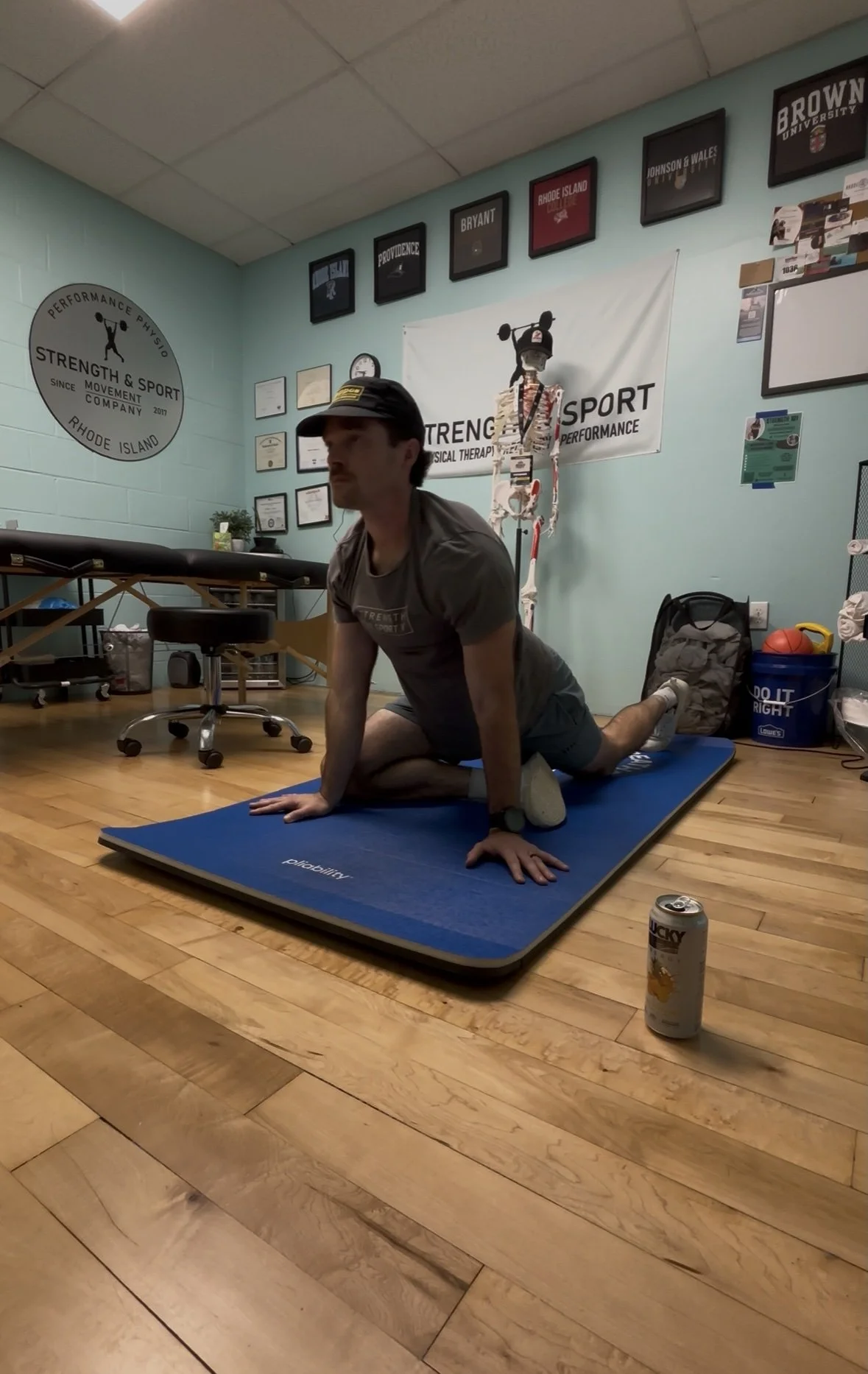
Journal: The first 4 days after a suspected Lumbar Disc Injury: A Physical Therapist Becomes the Patient
My Experience With Acute Lumbar Radiculopathy: A Physical Therapist Becomes the Patient
(First 4 days of a possible Disc related low back injury)
An ongoing injury journal about back pain, nerve irritation, inflammation, muscle guarding, and the decisions we make during recovery.
Day 1: Something Doesn't Feel Right
For approximately two weeks, I had been experiencing some left-sided low-back stiffness and discomfort, particularly in the morning. Nothing out of the normal,, I have tightness there from time to time, but it never prevents me from doing any activities. Initially, it seemed relatively manageable. I would wake up feeling stiff, move around throughout the day, and generally notice that things improved as I became more active. In other words, if you asked me to max out my deadlift.. I would have no problem.
Then, while walking at the gym, I felt a distinct "pop" in my lower back. Yes- just walking. Taking a normal step forward.
My back immediately tightened, and the discomfort progressively worsened throughout the day. What had previously felt like ordinary stiffness suddenly became something much more significant.
Over the next several days, the symptoms began extending beyond my lower back. I developed aching through my left lateral hip and down the outside of my left calf. I also noticed numbness at the tip of my left big toe, which eventually became more noticeable and seemed to involve more of the toe and foot.
Finding a comfortable position became one of the biggest challenges. Sitting, standing, walking, and lying in bed could all aggravate my symptoms. Both lumbar flexion and extension were uncomfortable. Even positions commonly recommended for back pain, such as prone extension and child's pose, were not particularly well tolerated. Sleeping was the worst. Every position was painful.
One finding that stood out during my own assessment was a strongly positive left slump test. Combined with the radiating pain and altered sensation, this made lumbar nerve-root irritation, or radiculopathy, a significant concern.
Interestingly, movement was not consistently bad. At one point, I completed a 30-minute walk that was tolerable and actually made me feel somewhat better. I was not pain-free, but gentle movement and changing positions seemed more helpful than remaining in one position for an extended period.
That became my first important observation: I was dealing with more than ordinary low-back stiffness, but complete bed rest is almost never a recommendation for this, gentle movement is almost always encouraged.
So i stayed vigilant on trying to stay moving, doing very very very gentle range of motion exercises (cat camel, quadruped rock backs, quad stretch, standing hamstring curls, calf raises, tow raises, mini squats)
I also went to the bohdi spa and was able to do 2 rounds, “as prescribed “in their water journey to help with some total body contrast between hot & cold to ideally promote some blood/ fluid exchange and reduce muscle tension.
The First Big Question: Is Inflammation Good or Bad?
As a physical therapist, one of the first things I started thinking about was inflammation.
We spend a lot of time talking about inflammation as something we need to reduce. Patients come into the clinic with an injury, and we discuss ice, anti-inflammatory medications, activity modification, and ways to calm down an irritated area.
But is inflammation actually bad?
The answer is more complicated than I initially thought.
Inflammation is a normal and necessary component of the body's response to injury. It helps initiate the healing process by recruiting immune cells, clearing damaged tissue, and coordinating the repair response. Without an appropriate inflammatory response, normal tissue healing would be impaired.
The problem is not necessarily inflammation itself. The problem can be an excessive, prolonged, or poorly regulated inflammatory response that contributes to pain, swelling, tissue sensitivity, and impaired function.
This distinction became especially interesting when considering a possible disc injury.
With lumbar radiculopathy, there may be a mechanical component, such as a disc protrusion or herniation irritating a nearby nerve root. But there can also be a chemical or inflammatory component. Disc material contains substances that can provoke an inflammatory response around the nerve root, potentially contributing to pain and altered nerve function even when the degree of mechanical compression is not severe.
In other words, the symptoms may not be explained by how much a disc is physically pushing on a nerve alone.
This made me question whether my primary goal should be to eliminate inflammation or simply allow the normal healing process to occur without unnecessarily interfering with it.
My conclusion was that I did not want to eliminate total inflammatory response. I wanted to avoid excessive or persistent inflammation while allowing the normal biological processes of recovery to take place.
This way we can have a happy middle ground of letting the body “do it’s thing” to help healing of the area using inflammation. But also find ways to control it, slightly reduce it, keep it manageable so that able to move my body more easily, decrease pain, and potentially reduce some pressure on that compressed nerve root.
That distinction matters when discussing medications.
Saturday Night and Monday Morning: My Decision to Use Ibuprofen
As the pain became more significant, I started using ibuprofen.
I took 800 mg on Saturday night and another 400 mg on Monday morning.
The thought process was fairly straightforward: if inflammation was contributing to the irritation around the nerve root, perhaps reducing that inflammatory response would help decrease pain.
NSAIDs such as ibuprofen inhibit cyclooxygenase enzymes (COX-1 and COX-2), reducing prostaglandin production. Prostaglandins are involved in inflammatory signaling and can contribute to pain sensitivity.
There is a reasonable physiological rationale for using an NSAID during an acute painful episode.
However, I also started thinking about whether suppressing inflammation was necessarily beneficial for the overall healing process. Could reducing inflammation interfere with the body's natural repair mechanisms?
The answer is that this is not a simple yes-or-no question. Inflammation is necessary, but reducing excessive inflammatory signaling can also be beneficial. The clinical effect depends on the injury, the medication, the dose, the duration, and the individual.
For acute lumbar radiculopathy, NSAIDs may provide symptomatic relief for some people, although the evidence for meaningful improvement is not particularly strong. They do not physically reposition a disc or guarantee recovery of an irritated nerve root.
The important distinction is between reducing pain and actually changing the underlying injury.
The Orthopedic Visit: A Suspected Disc-Related Radiculopathy
I eventually went to an orthopedic express clinic for an evaluation.
The clinician performed a neurological examination that included testing of the L4, L5, and S1 myotomes, great-toe extension, ankle dorsiflexion, plantarflexion, reflexes, and heel- and toe-walking. As a PT, i had already self tested many of these, but was very reassuring to get another professional to take another look.
Fortunately, these tests were reported as normal. I did not demonstrate an obvious focal motor deficit or foot drop.
However, I continued to experience numbness in my left foot and a strange sensation throughout my left leg. I described it as heaviness, altered coordination, and a feeling that my leg was not quite responding normally.
This raised an important clinical distinction: was I experiencing true motor weakness, altered proprioceptive or sensory feedback, pain-related inhibition, or some combination of these?
A normal strength examination is reassuring, but it does not rule out sensory-predominant radiculopathy. Someone can have nerve-root irritation and persistent sensory symptoms without demonstrating obvious weakness during a brief clinical examination.
X-rays were also performed. They did not demonstrate an obvious fracture or visible pars defect, although the clinician explained that some pars defects can be difficult to identify on plain radiographs. The X-rays did show decreased disc height and muscle spasm.
Of course, X-rays do not adequately visualize the intervertebral discs or nerve roots. They cannot reliably confirm a herniated disc or determine whether a nerve root is being compressed. MRI is much better suited to evaluating those structures.
The clinician felt that a disc-related problem with radiculopathy was the most likely explanation. The initial recommendation was conservative management, medication, and follow-up with a spine specialist.
We also talked about red flag symptoms- saddle area numbness, loss of bowel and bladder function, and progressing muscle weakness (for example- foot drop). That require a prompt call and visit to the ER. These are symptoms that i am very familiar with as a PT.
We discussed how that the vast majority people with disc-related (bulging. herniated) radiculopathy improve without surgery.
As a PT I knew this as well.. But always encouraging to hear! I also knew that persistent or progressive neurological symptoms needed to be monitored rather than simply ignored.
The Next Medication: Methylprednisolone
I was prescribed a methylprednisolone 4 mg Dosepak, a six-day oral corticosteroid taper.
This brought me back to my original question about inflammation.
If inflammation around an irritated nerve root was contributing to my symptoms, would a stronger anti-inflammatory medication make a difference?
Corticosteroids work differently from NSAIDs. Rather than primarily inhibiting prostaglandin production through COX enzymes, they influence gene expression and multiple inflammatory pathways, reducing the production of inflammatory mediators.
The rationale for prescribing a corticosteroid in acute lumbar radiculopathy is to reduce inflammatory activity around the irritated nerve root.
I found the evidence interesting. Research on oral corticosteroids for acute lumbar radiculopathy suggests that they may provide a modest improvement in function for some patients. However, meaningful pain relief is less consistent.
They do not physically reposition a herniated disc, decompress a nerve root, or guarantee that nerve function will recover faster.
I took the first six tablets of my Dosepak at approximately 8 a.m. with a substantial breakfast. I did not notice an immediate improvement in symptoms.
I was not particularly surprised. A lack of immediate relief after the first dose does not necessarily mean the medication will not help. If there is a benefit, it may become more apparent over the following several days.
One important medication-safety issue came up during this process: combining oral corticosteroids with NSAIDs such as ibuprofen or naproxen can increase the risk of gastrointestinal irritation, ulcers, and bleeding. I made sure to take with a large breakfast to protect my stomach.
Even though both medication classes have anti-inflammatory effects, combining them is not automatically better. I was advised to avoid additional NSAIDs during the steroid course unless my prescribing clinician or pharmacist specifically approved their use.
This was another reminder that reducing inflammation is not simply a matter of taking as many anti-inflammatory medications as possible.
Based on my research - I weighed the pro’s and con’s and decided to taking the 6 day steroid pack. I felt that it should help reduce that pain, and possibly help control (not eliminate) some of that excessive inflammation, possibly giving that nerve a little more space.
The Muscle Relaxant: Is Muscle Guarding Helping Me or Hurting Me?
I was also prescribed cyclobenzaprine 10 mg to take as needed at bedtime.
This led to what was probably my most interesting internal discussion.
When someone experiences acute low-back pain, it is common to see increased muscular activity and protective guarding around the painful region. The muscles tighten, movement becomes restricted, and the person may feel like their back is constantly bracing.
But is this guarding actually beneficial?
My initial thought was that the body may be using muscular contraction to protect an irritated spinal segment. If I take a muscle relaxant, could I potentially reduce a protective response that the body actually needs?
And further more- what about massage, or perform extensive dry needling, e-stim modalities?… all of which I use to help decrease muscle spasm & guarding.
I started questioning whether I was trying to relax muscles that were tightening for a reason.
The more I thought about it, the more I realized that muscle guarding is not inherently good or bad. It depends on the context.
In the early stages of an injury, increased muscular activity may serve as a protective response. It can limit certain movements, reduce exposure to painful positions, and change how the spine is loaded.
However, prolonged or excessive guarding can also become counterproductive.
It may contribute to stiffness, increased energy expenditure, reduced movement variability, pain sensitivity, and difficulty returning to normal activity. The nervous system can become increasingly protective even when that degree of protection is no longer necessary.
There is also an important distinction between protective co-contraction and normal coordinated spinal stability.
We should not assume that tight paraspinal muscles are effectively protecting or decompressing an irritated nerve root. Nor should we assume that reducing muscle tone automatically creates instability.
The goal is not to have the muscles maximally relaxed or maximally contracted. The goal is appropriate muscular coordination for the activity being performed.
Cyclobenzaprine is a centrally acting medication. It does not selectively relax the multifidus, paraspinals, or any particular muscle group. It is intended to help manage muscle-spasm symptoms through its effects on the central nervous system.
The other theory is that if the muscles are very tight, and causing a noticeable straieghtening in my vertebrae (as seen in the X-ray)... could the muscle spasm help reduce this tension, and reduce pressure on the nerve?
I took one 10 mg tablet at night. I noticed mild drowsiness, but not much improvement in pain. I still struggled to find a comfortable sleeping position.
That made me question how much of my discomfort was actually related to muscular spasm versus the underlying nerve-root irritation.
I also considered whether reducing muscular guarding through medications or passive treatments could leave me feeling better without actually improving the underlying condition.
My takeaway was that symptom relief should not be confused with tissue readiness. If a medication makes me feel less pain, that does not automatically mean I am ready to return to heavy lifting or aggressive exercise.
Based on my research: I decided to continue taking the muscle relaxor at night to assist with sleep, to help control (not eliminate) some of that muscle spams and guarding to reduce pain, get more sleep (which is important for recovery), and potentially take some of the pressure off that nerve root.
Could Other Treatments Improve Blood Flow and Healing?
As a physical therapist, I naturally started considering other interventions that might help the recovery process.
One concept I considered was whole-body contrast therapy at the Bohdi spa. The idea was to use a hot tub at approximately 104°F, followed by a cold plunge around 50°F , and alternating hot tubs also with 180 degree sauna and steam room for two minutes, repeating the process.
The theory was that alternating vasodilation and vasoconstriction could increase circulation, move inflammatory waste products, and bring fresh blood and healing resources to the injured area.
Contrast therapy may help some people feel better, but there is not convincing evidence that it flushes inflammatory waste from a spinal nerve root, reduces disc-related nerve inflammation, or accelerates disc healing. But I thought it would be worth a try. It did also produce a nice decrease in muscle tension.
I also considered high-intensity laser therapy, or Class IV laser therapy. There are plausible mechanisms involving photobiomodulation and potential modulation of pain and inflammation. Some clinical studies suggest short-term improvements in pain or disability when laser is added to rehabilitation, but the evidence is limited and protocols vary considerably. But I also thought that this would be worth a try.
I thought about soft tissue techniques: dry needling, electrical stimulation, massage, Graston/IASTM, and cupping as well.
These interventions may have a role in addressing secondary muscular discomfort or providing temporary symptom relief. SoIi wanted to give these a shot too.
TENS primarily provides sensory stimulation and may influence pain perception. NMES produces muscle contractions and can create a local muscle pump that temporarily increases blood flow in the contracting muscle. That is physiologically interesting, so i wanted to incorporate this.
I own a Compex Sport Elite, which produces strong muscle contractions, and a TENS machine, which produces more of a tingling sensation. The Compex is more relevant if the goal is rhythmic muscle contraction, whereas the TENS unit is primarily intended for sensory stimulation.
I also came back to my earlier concern about excessive muscular relaxation. If I were to combine muscle relaxants, aggressive massage, dry needling, and other passive treatments, would I actually be helping myself, or simply changing the sensation of the injury?
I ultimately decided that there is a delicate balance with all of this. Our bodies are designed to heal themselves. We are all mini-versions of Wolverine from the X-Men, with extraordinary healing power. These medications, PT treatments, and other modalities can all be used to help the body achieve this. Our job is to want to create an environment to help the body heal, and try not get in it’s way, or slow it down.
If something makes me feel better without aggravating symptoms, it may have a place. On the other side of the coin- I think that we don’t need to get caught up in trying to completely eliminate muscle guarding, eliminating inflammation. Instead- just helping the body have the “right amount” to promote healing.
Where I Am Now: Monitoring, Movement, and Recovery
At this point, my focus is on what I can control.
I want to avoid prolonged bed rest while also avoiding aggressive loading or repeatedly provoking the radiating symptoms.
Walking has been one of the more tolerable activities. Rather than forcing a particular exercise or stretching position, I am focusing on comfortable movement and changing positions regularly.
I am also monitoring the neurological symptoms, particularly the numbness in my left foot and the unusual heavy or uncoordinated feeling in my left leg.
The formal strength examination was reassuring, and the symptoms have not clearly worsened over the most recent day. However, they have not resolved either.
I do not want to confuse stable symptoms with recovered neurological function. Persistent or progressive numbness and coordination changes deserve follow-up, even when obvious weakness is absent.
New or progressive weakness, foot drop, worsening difficulty walking, saddle or perineal numbness, urinary retention or difficulty emptying the bladder, or loss of bowel or bladder control would warrant urgent emergency evaluation.
My plan is to continue tolerable activity, prioritize sleep and nutrition, follow the medication instructions, and contact the orthopedic clinic about persistent neurological symptoms rather than simply waiting six weeks for the spine specialist appointment.
My Biggest Takeaways So Far
This experience has reinforced that lumbar radiculopathy is not simply a muscle-spasm problem.
There may be mechanical irritation, inflammation, altered nerve function, pain-related muscle guarding, and changes in movement behavior occurring together. Each may contribute to the overall experience, but not every treatment addresses every component.
I have found myself coming back to two questions:
1. Is inflammation good or bad?
Inflammation is necessary for normal healing. The goal is not to eliminate every inflammatory response. However, excessive or prolonged inflammatory activity can contribute to pain and sensitivity. Medication may help manage that response, but reducing inflammation does not necessarily correct the underlying mechanical problem.
2. Is muscle guarding good or bad?
Muscle guarding may initially serve a protective purpose, but excessive or prolonged guarding can contribute to stiffness, pain, and impaired movement. The goal is not to eliminate muscle activity. It is to restore appropriate, coordinated muscular control.
As both a physical therapist and a patient, I find it valuable to experience the uncertainty firsthand. It is one thing to explain radiculopathy to someone in a clinic. It is another thing to experience radiating pain, numbness, disrupted sleep, and the uncertainty of not knowing exactly how the next several days will unfold.
My goal is not to find the most aggressive way to eliminate pain. It is to understand what is happening, manage symptoms safely, monitor neurological function, maintain tolerable activity, and allow the body an opportunity to recover.
I plan to continue documenting the process, including which interventions actually make a difference and how my symptoms change over time.
The next big steps in my journey will be getting the symptoms under control, getting my range of motion and flexibility back, and then returning to the gym and triathlons.
Disclaimer: This article documents my personal experience and clinical thought process. It is intended for educational purposes and is not a diagnosis or individualized treatment recommendation. Imaging, medication, and treatment decisions should be made with an appropriately qualified healthcare professional. New or progressive neurological symptoms require prompt medical evaluation.